-
How Does the NuovoTeam Push-to-Talk App Solve Field Service Communication Challenges?
Almost 2 billion people worldwide are field service workers who work in task-oriented roles at remote locations and are constantly on the go. These field service workers interact with your customers, represent your brand and cater to real-world challenges. Be it employees who work at warehouses, manufacturing lines, construction sites, mining sites or logistics and delivery companies, what they lack and deserve the most is seamless and quick communication. Although several enterprises belonging to these industries provide legacy two-way radios such as walkie-talkies or land mobile radios, in today’s mobile-first world, radio communication does not cut it. This is why several businesses are turning towards Push-to-Talk over cellular networks.
Push-to-Talk is a mechanism that allows two users to connect with each other using a simple push-button action. Legacy walkie-talkie radios use this same push-button mechanism to establish a half-duplex communication between the sender and the receiver. Thanks to technological advances, this PTT capability can now be integrated into smartphones and rugged devices using powerful Push-to-talk apps.
What is NuovoTeam?
NuovoTeam is a push-to-talk app that is designed to keep the field employees well-engaged and connected on the go. It can be easily integrated into Android, iOS smartphones, as well as rugged smartphones and custom-built devices. Unlike walkie-talkie radios that require dedicated handsets and licenses, NuovoTeam needs to be simply installed on the users’ devices to enable them to use their smartphones as walkie-talkies. In a mobile-first world, all field industries require not just communication, but real-time collaboration. In view of this, NuovoTeam offers its users a complete suite of communication features right from text messaging to multi-media sharing. It is one app that can cater to all your field communication needs.
Read more: What is a Push-to-Talk app?: A Fundamental Elaboration
Challenges of Field Workers & How NuovoTeam Helps To Mitigate Them
1. Communicating in Harsh Environments
Most field operations are labor intensive with heavy-duty machinery and harsh terrains. Picking a mobile device for your field employees is vital to creating a seamless communication experience. Most field employees carry more than one mobile device to work. While some businesses provide dedicated walkie-talkie radios to their field workforce, others provide them with rugged devices to sustain the harsh field environments. But the challenge of juggling between several devices in a noisy outdoor environment still persists.
How NuovoTeam helps: NuovoTeam is a Push-to-talk app that can be easily installed on smartphones, as well as rugged devices. With this, your employees can simply carry one rugged smartphone to work that can offer a plethora of instant communication features for your employees. No more need to switch between multiple devices at work.
2. Lack of Collaboration
Voice communication is important for your field workforce, it adds a human element and ensures clarity when conveying messages. However, with today’s dynamic work environments, your field workforce has to manage unpredictable situations and emergencies. Just voice communication is not enough, businesses need to collaborate with their field force management software on the go. Effective collaboration is built on mutual understanding and shared goals, as highlighted in resources like these 225 quotes about teamwork.
How NuovoTeam helps: NuovoTeam offers a wide array of features from instant voice communication such as push-to-talk and VoIP calls, to other means of communication including video messaging and text messaging. Your field employees can instantly share high-quality images, files, as well as their current locations using NuovoTeam.
3. Ineffective Group Communication
Field communication does not just mean connectivity between field employees. Your field employees also need to connect with their line managers, supervisors, subject-matter experts and other remotely located teams. Walkie-talkie radios have geographical limitations and enable only line-of-sight connectivity. Phone calls provide global connectivity, but are too time-consuming as users have to undergo specific dialing protocols and can connect only with one person at a time.
How NuovoTeam helps: NuovoTeam allows companies to create public and private channels to establish group PTT calls. With this, your field employees can connect with multiple people from anywhere in the world. This simplifies communications and ensures that all the concerned employees are on the same page.
4. Non-Secure Business Conversations
Although field communications are different in comparison to office communications, one thing that remains common is data security. Businesses that have a field workforce experience a greater threat of their corporate data being leaked. Legacy walkie-talkies do not offer encryption. Radio frequencies are shared between multiple users or organizations which makes it very easy for strangers to gain access to your private conversations. Ensuring the confidentiality of the sensitive business information that is being relayed back and forth with your field employees is a great challenge.
How NuovoTeam helps: NuovoTeam understands that businesses have to suffer heavy revenue losses and legal and financial penalties if they encounter corporate data breaches. That is why the communication made from the NuovoTeam software is secured with 128-bit encryption.
5. Lack of Safety & Seamless Crisis Communication
Hands-free connectivity is when users do not have to engage themselves in physically receiving a call or reverting to it. This capability is something that field employees require the most given the fact that they are heavily engaged in labor-intensive processes and sport bulky protective gear such as helmets, gloves and safety suits. Receiving a phone call means that the field employees have to surrender the equipment in hand, and remove their gloves and helmet just to pick up a call. This not only puts the employees at risk but also lowers their productivity. In emergencies when lives are on the line, this cumbersome process is highly ineffective.
How NuovoTeam helps: NuovoTeam allows users to receive barge calls as and when they arrive, without the need to manually receive a message. With this, employees can focus on the task at hand and still be updated with all the latest information in a hands-free and eyes-free manner.
Closing Lines
Today’s field service workers have to survive volatile environments wherein communication can make or break their day. It is crucial that businesses opt for evolving technologies as times change. NuovoTeam PTT app helps businesses combine the pros of walkie-talkie radios and modern-day communication tools and delivers streamlined connectivity for all.

-
Understand the Difference Between Simplex, Half Duplex & Full Duplex Communication
We live in a hyper-connected world where communication is the key to business success. From hand-written letters to emails, from phone calls to video conferencing and from walkie-talkies to cellular push-to-talk apps, communication has greatly evolved to facilitate instant global connectivity. As more and more businesses rely on mobile devices to keep their field workforce connected, push-to-talk apps are gaining popularity.
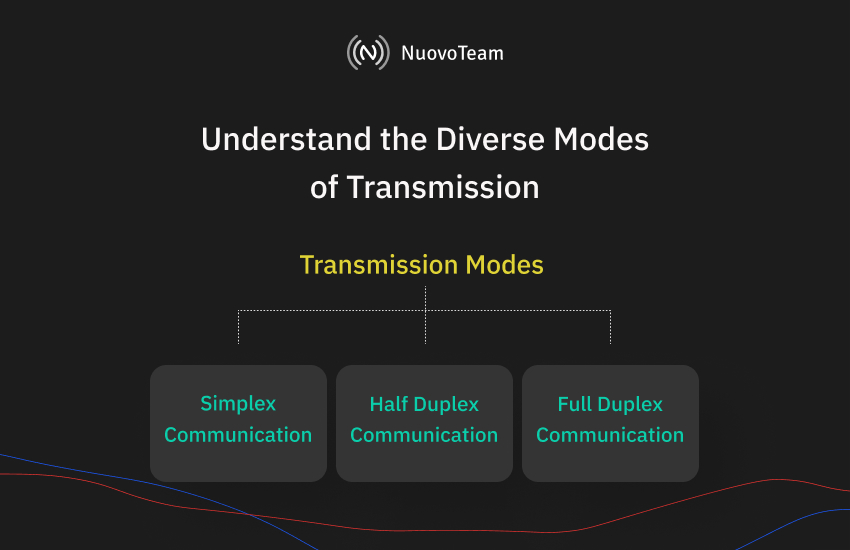
If you have worked in the field, or if your business has a field workforce then you must already be familiar with the term push-to-talk. It is a half-duplex communication mode that is used by devices such as walkie-talkies and land mobile radios. But what does half-duplex mean? If walkie-talkies work on a half-duplex mode of communication, then does a full duplex exist too? Let’s understand the various modes of communication.
What is Simplex Communication?
Simplex communication is a uni-directional mode of communication in which two devices are connected, but only the sender can transmit messages and the receiving end can simply listen. This mode of communication creates a one-way channel for information transmission.
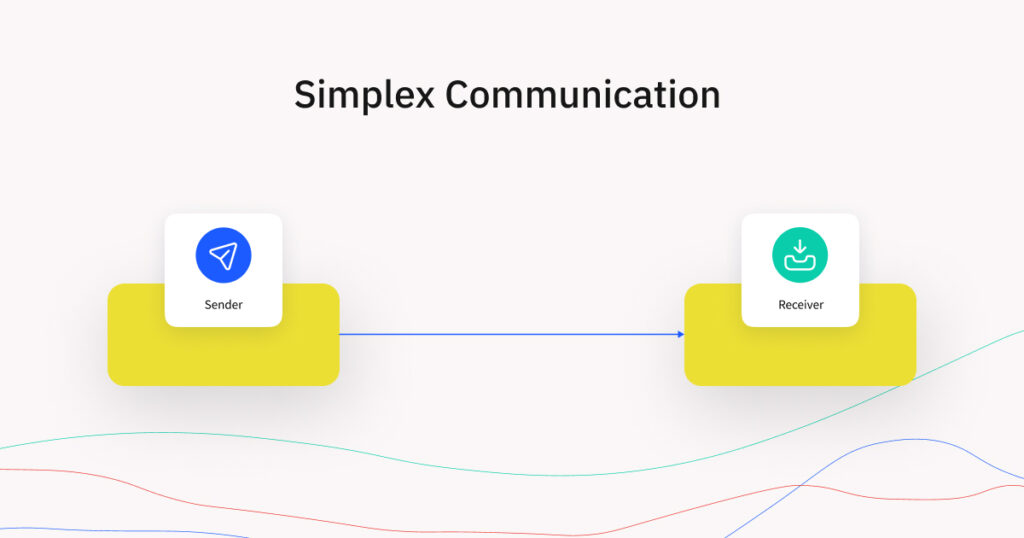
Simplex Communication Advantages of simplex communication:
- It is a one-way transmission and utilizes the full capacity of the communication medium.
- Enables greater data transmission at a time since the entire bandwidth is utilized.
Disadvantages of simplex communication:
- Presents only unidirectional communication.
- No inter-communication between devices.
- Cannot be widely used for modern-day communication.
What is Half Duplex Communication?
Half-duplex communication is when two devices are connected, and both the sender and the receiver can communicate, but not simultaneously. It is a bi-directional mode of communication in which the sender and receiver can transmit voice messages one at a time.
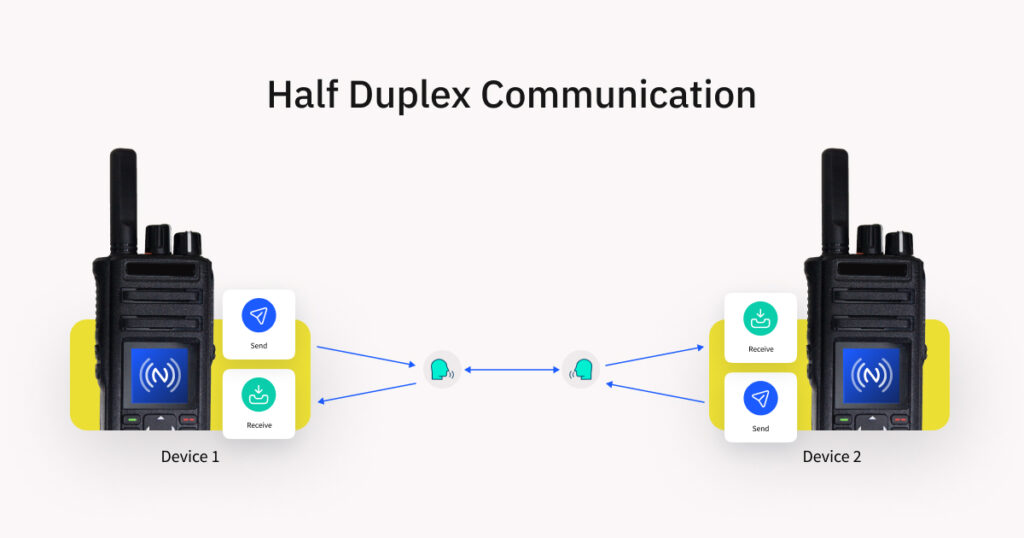
Half Duplex Communication Advantages of half-duplex communication:
- It is easy to implement.
- No hardware complications.
- Offers time-saving communication.
- Can be leveraged over cellular and radio networks.
Disadvantages of half-duplex communication:
- Lower speed and performance in comparison to the full-duplex method.
What is Full Duplex Communication?
Full-duplex communication is a bi-directional mode of communication in which both the sender and the receiver can communicate simultaneously. Unlike half-duplex communication, full-duplex communication can establish a continuous two-way connection. Many modern Cloud Communication Platforms leverage full-duplex communication to enable seamless real-time interactions between users.
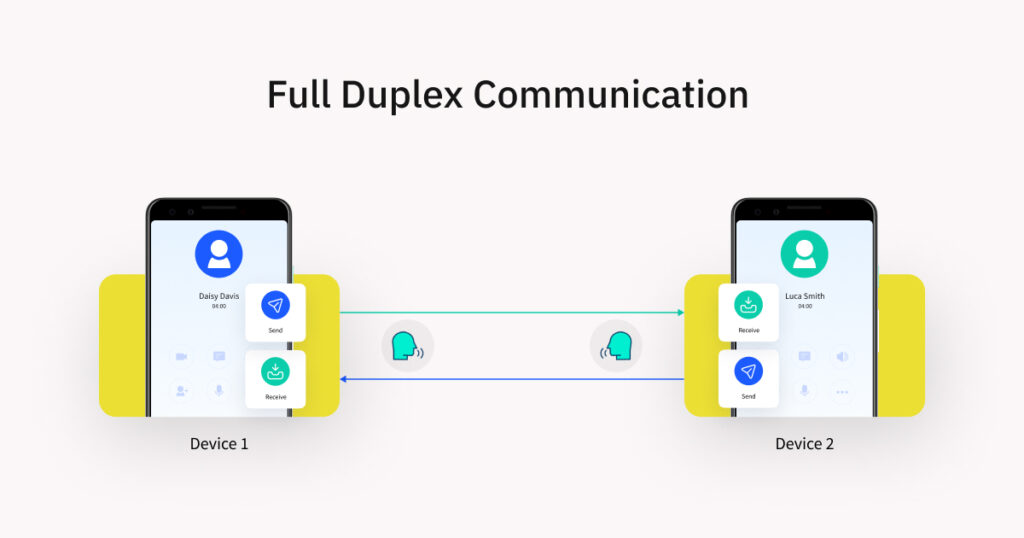
Full Duplex Communication Advantages of full-duplex communication:
- High performance in comparison to half-duplex communication is particularly noticeable in intranet environments where simultaneous communication is crucial. This is especially useful when integrated with efficient intranet software solutions.
- Faster speed of transmitting and receiving the data.
- It doubles the utilization of the bandwidth.
- Best suited for modern-day office communication.
Disadvantages of full-duplex communication:
- Not all network equipment supports a full-duplex system.
- Connectivity may be time-consuming in comparison to half-duplex communication.
- Sometimes causes difficulty for the administrators to diagnose the issue in the network due to instability.
Difference Between Simplex, Half Duplex, and Full Duplex Modes of Transmission:
Parameter
Simplex Communication
Half-Duplex Communication
Full-Duplex CommunicationDirection of communication It is one-way communication in which only the sender transmits the message and the receiving end hears the message. It is two-way communication in which both the sender and the receiver can transmit messages, but one at a time. It is two-way communication in which both the sender and the receiver can transmit messages simultaneously. Sender & Receiver The sender can only send the data but not receive it. Both sender and receiver can send and receive the data. Both sender and receiver can send and receive the data. Bandwidth Simplex communication makes full use of a single bandwidth. Half-duplex communication makes lesser use of a single bandwidth in comparison to full-duplex mode. Full-duplex communication doubles the use of transmission bandwidth. Performance Yields a lower performance compared to half and full-duplex modes. Yields a lower performance when compared to the full-duplex mode of communication Yields the maximum performance as it makes use of double the bandwidth. Examples Televisions, radios, monitors, keyboards and microphones connected to speakers. Walkie-talkies, two-way radios, land mobile radios. Cellphones, telephone lines. Industry Use-Cases Emergency services, security services, healthcare, education, retail. Construction, Logistics, Retail, Warehousing, Mining, Security services, Emergency services. All industries. Why Is Half-Duplex Communication Ideal for a Field Workforce?
While most of the corporate world enjoys the benefits of full-duplex communication, some industries with a field workforce find cellular phone calls cumbersome and futile. Industries such as construction, warehousing, logistics and transportation, etc. have a field workforce that operates from remote, high-risk environments where speedy communication is critical. Pairing half-duplex communication with a knowledge base builder ensures that teams have both instant verbal updates and centralized access to important documents or protocols. Two-way radios such as walkie-talkies leverage half-duplex communication to offer instant push-button connectivity.
The field workforce functions in hazardous locations and operates heavy equipment. Here are some reasons why half-duplex communication outstands full-duplex communication for field employees:
- Hands-free communication
- Quick press-button connectivity
- No fuss of dialing numbers and typing long messages
- Straightforward and no-frills communication
Also read: How Does the NuovoTeam Push-to-Talk App Solve Field Service Communication Challenges?
Leveraging Half-Duplex Communication With NuovoTeam Push-to-Talk
What if we told you that there is a way that you can leverage the benefits of half-duplex communication straight from your smartphone? NuovoTeam is a Push-to-Talk (PTT) app that allows your smartphone to mimic the functionality of a half-duplex walkie-talkie device. Field workforce and leverage instant communication without the need to carry around extra radio communication devices.
Here’s why NuovoTeam PTT is the ideal solution to streamline your field communication:
- Highly compatible: NuovoTeam can be easily installed on Android, iOS smartphones, rugged smartphones and custom-built devices.
- Push-Button Connectivity: Users can leverage clear and stable push-button connectivity over cellular networks.
- Desktop PTT: PTT calls can be leveraged from any machine that has a Chrome browser to keep the office staff connected with the field workforce.
- SOS Communication Channel: Employees can initiate an SOS alert that includes a 10-second PTT message followed by auto-sharing of the employee’s current location.
- Group Communication: You can create public and private channels to make group PTT calls.
- Location Tracking: Field employees can be tracked easily with location monitoring capabilities.
- Live Voice Playback: You can replay previous PTT messages to revisit critical conversations.
- Multi-Media Messaging: You can send text messages, images, videos or files in diverse formats
Read more: 6 Things You May Not Know About Modern-Day Push-to-Talk
Closing Lines
While simplex communication may be the best choice where a response is not critical, full-duplex communication is largely preferred for modern-day corporate communications. However, with the growing number of field services, half-duplex communication is regaining its limelight. When critical factors such as productivity, operational efficiency, customer satisfaction and business growth are dependent on effective communication, enterprises must carefully pick what works best for them.
Explore seamless half-duplex communication designed for the modern-day field workforce with NuovoTeam.
-
Understanding Push-to-Talk: 10 Important Questions Answered
Field and frontline communication are nowhere close to office communication. Then why must the modes of communication be the same for both? Push-to-Talk is a familiar concept for businesses that have a field workforce. It is faster and safer when it comes to keeping the field workforce connected with their team members and office staff. However, push-to-talk has evolved with time and we now have Push-to-talk services that offer more secure connectivity on a global scale.
Here are 10 questions that will bring you to date with push-to-talk.
Top 10 Questions About Push-to-Talk (PTT) Answered
1. What is PTT?
Push-to-Talk is a half-duplex communication mode used in popular two-way radio devices such as walkie-talkies. It allows users to communicate with the press-button transmission using handheld devices. Invented in the early 1900s, traditionally the PTT technology was designed to be used over radio frequencies to help the field workforce and frontline teams communicate with their on-site team members.
2. How does PTT work?
Push-to-Talk works on the half-duplex mechanism, meaning that users can communicate bi-directionally, but one at a time. Unlike the full duplex communication used by cellular phone calls, in which users can talk to each other simultaneously, push-to-talk devices such as walkie-talkies and land mobile radios (LMRs) allow only one person to talk at a time. Traditionally this PTT communication was leveraged using radio networks. Now, modern-day forms of PTT communication use cellular networks and Voice over internet protocol (VoIP) to establish PTT connectivity.
3. Does PTT still exist?
Push-to-Talk is one of the fastest modes of communication that helps several industries where quick connectivity is critical. Although Push-to-Talk radios like walkie-talkie radios and land mobile radios have failed to evolve with time and are rarely used today, Push-to-Talk technology is far from being obsolete. With advances in technology, the PTT functionality has been added to several other devices including smartphones. We now have PTT apps such as NuovoTeam which can be downloaded on the users’ smartphones to leverage push-button connectivity over cellular networks.
Know all about PTT apps: https://blog.nuovoteam.com/what-is-a-push-to-talk-app-a-fundamental-elaboration/
4. Why have PTT radios disappeared?
There were times when two-way radios that delivered push-button radio connectivity were largely used by field workers to stay communicated with their on-site teams. However, today we live in a mobile-first world with new and better technologies arriving every day, such as the 5G network. Today, businesses focus on operational excellence and customer satisfaction. Keeping these factors in mind, radio communication just does not fit in today’s world. It presents several barriers to seamless communication such as limited frequency range, low audio quality and lack of security. It is safe to say that radios are a thing of the past and several businesses now are preferring cellular connectivity over radio networks.
5. What is Push-to-Talk over cellular (PoC)?
Push-to-Talk over cellular is a modern-day alternative to two-way radios. As the name suggests, push-to-talk over cellular or PoC offers users push-button connectivity over cellular networks. With this, users can leverage ultra-fast PTT connectivity straight from their smartphones over 3G, 4G, 5G or WiFi networks. PTT over cellular offers nationwide or global coverage, unlike radio-based PTT devices which offer connectivity over a limited area. Today’s field businesses experience immense benefits with PTT over cellular, as they can stay connected with their teams from anywhere in the world.
6. Can a smartphone be used as a walkie-talkie?
There are powerful Push-to-talk apps such as NuovoTeam available in the market today that allow users to leverage PTT over cellular networks. With this, enterprises do not need to invest in purchasing dedicated handsets or worry about radio communication licenses. Simply installing an efficient PTT app on the users’ smartphones can help turn the device into a walkie-talkie.
7. Why use PTT apps?
Field workforce or frontline employees operate from remote environments and are constantly on the move. The push-to-talk mechanism is devoid of complex direct dialing or messaging procedures. With modern-day PTT workplace applications integrated into smartphones, all that the users have to do is press a single button to obtain both, one-to-one or group connectivity. This is beneficial for field communication since various teams can communicate instantly from anywhere in the world, and line managers and supervisors can keep their employees engaged throughout.
Besides, modern-day PTT apps extend a comprehensive range of features for the users such as;- Video and multi-media messaging
- Text messaging
- File sharing
- Location sharing
- Corporate directory integration
- Channel management for group calls
- MDM integration
- Encrypted connection
8. PTT is ideal for which industries?
Push-to-talk has been immensely popular for businesses that have a field workforce. You may have seen several field employees such as construction workers, mine workers, etc. use walkie-talkies to stay connected with their fellow colleagues. Push-to-talk apps simplify field communication even further and remove the limitations of radio communication.
Push-to-talk apps are ideal for the field workforce and frontline workers belonging to the following industries:
- Construction
- Mining
- Logistics & Transportation
- Manufacturing
- Warehousing
- Retail
- Hospitality
- Security services
- Emergency services
9. Is PTT secure?
Radio communications are not very secure since radio frequencies are generally shared by multiple users. When it comes to relaying sensitive business information, there are chances of corporate data leakage over radio communication. However, modern-day PTT connects users over cellular frequencies which are generally secured with either 128-bit or 256-bit encryptions. This makes it complex for hackers to intrude on secure communications.
Moreover, powerful PTT apps like NuovoTeam understand that privacy is critical when it comes to corporate communications, hence it offers 128-bit encryption for all the communication made from the software.
10. Can PTT connect your office staff to your field workforce?
As PTT apps gain traction worldwide, they are being developed in a way to help field businesses streamline their communications effortlessly. Push-to-talk services such as NuovoTeam offer desktop PTT functionality which enables the office staff to make PTT calls from their PCs, macOS or Linux machines. This means that employees working from offices need not toggle between their desktops and smartphones just to make PTT calls. They can stay seamlessly connected with their field workforce straight from their desktops.
Closing Lines
Radio communication may slowly be turning obsolete, but push-to-talk is here to stay. Comprehensive PTT apps like NuovoTeam help your business improve its operational efficiency and improve its revenue. If you have a field workforce and wish to streamline your field communication in the most efficient way, the NuovoTeam PTT app is just what you need.
-
Benefits Of Push to Talk Services For Businesses?
In a hyper-competitive world where businesses are digging deep to analyze factors that can improve their operational efficiency and revenue, Push-to-Talk services are gaining popularity as many believe they help businesses cut down costs significantly.
Businesses that have a field workforce, especially, are inclined towards adopting Push-to-Talk (PTT) services to streamline their field communications. Seamless and fast communication is the key to achieving operational excellence when your employees are scattered across the globe. So how do Push-to-Talk services help businesses streamline their budgets and save money? Read this article to find out. But before you do, let’s understand what modern-day PTT services are and how they are different from traditional PTT devices.
Push-to-Talk Services: How Are They Different From Walkie-Talkie Radios?
Back in the day, site workers belonging to diverse industries relied on two-way radios to communicate with their crew members. Walkie-talkies and Land Mobile Radios were mainstream as they delivered instant push-button connectivity. But the modern-day PTT solutions differ from the traditional push-to-talk radios in several ways. Here’s how.
- Network: Unlike traditional walkie-talkies that operate on radio frequencies, the modern-day PTT services make use of cellular networks and have the ability to be integrated into Android and iOS smartphones or even rugged smartphones.
- Coverage: Radio communication is limited to a specific area since radio waves travel in a straight line and do not penetrate solid obstacles like trees, walls, etc. Modern-day PTT solutions that run on cellular networks offer a much larger coverage. You can communicate nationwide or even globally with modern-PTT apps.
- Audio Quality: Walkie-talkie radios produce a significant amount of static which hampers the call quality. Moreover, the audio quality varies based on the distance between the sender and the receiver. PTT over cellular (PoC) is devoid of these challenges.
- Security: Information that is transmitted over radio frequencies is not completely secure. There are chances that multiple users use the same radio frequency as your organization. Cellular networks offer greater data security which is essential for businesses.
- Costs: Radio communication requires businesses to invest in dedicated handsets for their field employees. Also, operating two-way radios requires companies to purchase licenses in many parts of the world. PoC on the other hand can be easily integrated and used on smartphones without special permissions or the need for extra devices.
Read more: 7 Reasons Why Radios Are Slowing Down Your Company’s Growth
How Can Businesses Save Money by Adopting Push-to-Talk Services?
1. Save Costs on On-Site Visits
Modern-day PTT solutions are apps that can be easily installed on your field employees’ devices to turn their smartphones into walkie-talkies. With this, line managers and office staff that are located anywhere in the world can easily connect with their field workforce without paying frequent site visits. PTT apps make anywhere connectivity possible and supervisors can manage their field employees remotely across diverse geographies.
2. Reduced Equipment Costs
With traditional radio communication, businesses have to invest in purchasing dedicated handsets for every on-site employee. The cost of the legacy two-way radios is extremely high for the poor audio quality and range limitations that they offer. Push-to-Talk apps work on subscription models and do not require businesses to invest in special dedicated devices. Opting for a PTT-based model over hardware-heavy systems is a cost-efficient business decision that aligns with modern BYOD practices.
3. Reduce Call Costs With Group Communication
Most modern-day PTT apps allow 1-1 and group communication abilities for the users. Rather than spending extra time and costs on making individual phone calls to your field employees, with PTT apps you can create multiple groups based on your employees’ locations, projects or departments. PTT apps help businesses leverage push-button group connectivity for mass communication and team discussions. This not only helps businesses save costs on long and multiple cellular phone calls but also ensures that all teams are effectively engaged and informed.
4. Cut Down Radio Licensing Costs
Although there are both unlicensed and licensed two-way radios, professional communication requires businesses to abide by strict guidelines and purchase radio licenses based on which part of the world they are in. With PTT service, your business is free from any licensing charges or special permissions.
5. Streamlined Operational Efficiency
Statistics suggest that about 86% of employees consider lack of effective communication as the reason behind business failures. Well-connected teams display a 20-25% increased productivity. Streamlined communications leave no space for errors and help businesses boost their employee productivity. When your field workforce is clear of its roadmap and goals, it helps them deliver better customer service, driving better revenue.
Closing Lines
Profits and revenues are directly impacted by business decisions. Trimming costs to boost profits can be possible if you can identify powerful tools that cater to all your business needs without burning a hole in your pockets. Field communications are a vital aspect of every business and must not be overlooked. You can experience cost savings and seamless remote connectivity with modern-day PTT services like NuovoTeam.
-
6 Things You May Not Know About Modern-Day Push-to-Talk
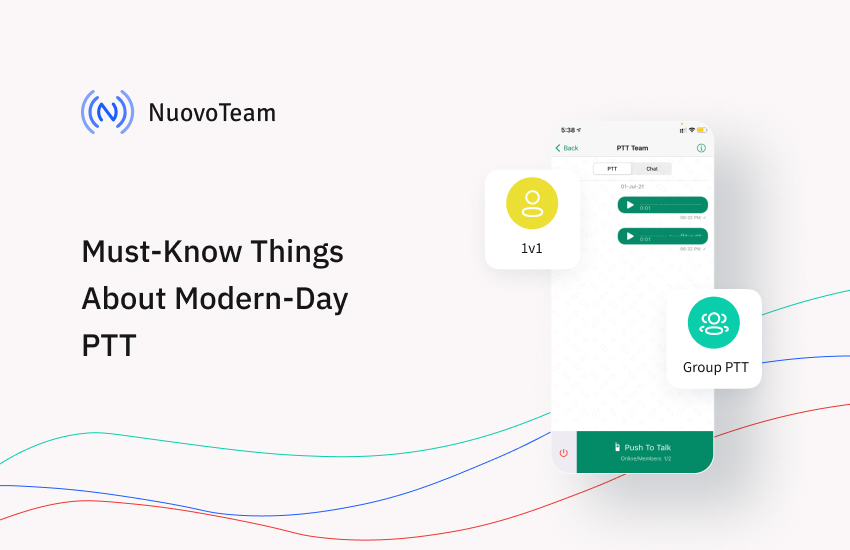
If your business has a field workforce, you may already be aware of the concept of Push-to-Talk. Push-to-Talk (PTT) devices have tremendous applications in diverse industries that have a field workforce such as logistics, mining, manufacturing, etc. Frontline workers including firefighters, security agents, etc. also use walkie-talkies that let them communicate with their crew at the push of a button. However, with the ever-evolving corporate landscape, technology is evolving rapidly. The Push-to-Talk that you may know has now been modified to cater to modern-day field communication requirements. In this article, we will highlight some significant aspects of the modern-day PTT that you ought to know.
Push-to-Talk: Then & Now
In older days, when mobile phones were not mainstream, field workers used two-way radios to communicate with their on-site colleagues. This radio connectivity was achieved using special handheld devices such as walkie-talkies or Land Mobile Radios (LMRs). These devices worked on the concept of Push-to-Talk enabling instant connectivity, simply by pressing a button.
Soon after, mobile phones which operate on cellular networks took over corporate communications. Cell phones changed business communications forever since they offered global coverage, better audio quality and scalability. Today, almost every person owns a smartphone. Companies extend various policies to enable their employees to use smartphones such as COPE, BYOD, CYOD, etc.
But smartphones, no matter how slick and functional for the desk workers, do not simplify communication for deskless employees. While the rest of the corporate world communicates via phone calls and emails using their smartphones, these modes of communication are slow and unreliable for the field workforce. This is where Push-to-Talk regains its value.
Businesses that have a field workforce cannot completely rely on modern-day communication methods. Thankfully, Push-to-Talk has evolved to offer connectivity over cellular networks. This modern-day PTT is called Push-to-Talk over Cellular (PoC).
6 Things You Need To Know About Modern-Day PTT
According to a report, the global Push-To-Talk market size is projected to reach USD 25.22 billion by 2027. The rapid growth of this market is due to the large-scale adoption of Push-to-Talk over cellular (PoC) by several enterprises worldwide.
In light of the high demand for modern-day PTT apps or PoC, here are some crucial things that you must know.
1. Your Smartphones Can Be Turned Into Walkie Talkies
Modern-day PTT technology enables businesses to turn their employees’ smartphones into walkie-talkies. All that is required is a powerful PTT app such as NuovoTeam which can be installed like any other app on Android, iOS, rugged smartphones or custom devices. With this, your employees can leverage cellular PTT connectivity without carrying multiple devices to communicate on-site. Not only can your employees leverage high audio quality but also connect with their team members and line managers from anywhere in the world.
2. You Can Leverage Group-Specific Communication
When communicating with a remote field workforce, time and clarity are of the essence. You can create groups based on your field employees’ locations, departments, etc. to convey business-critical information to multiple people at once. This saves precious minutes spent on calling multiple employees individually and also makes group discussions convenient and fast.
3. Remote Employee Management
For maximum operational efficiency, line managers need to be aware of the whereabouts of their field employees. Modern-day PTT apps allow users to share their current locations to keep their crew members and line managers updated about their positions. Comprehensive PTT solutions like NuovoTeam also enable supervisors to manage their employees remotely by tracking their attendance statuses, as well as daily clock-in and clock-out timings.
4. Cross-Platform Interoperability
The primary aim of modern-day PTT technology is to keep the office staff and the field workforce seamlessly connected. To achieve this goal, PTT apps easily integrate with commercial smartphones such as Android and iOS, as well as rugged smartphones which are generally preferred for field jobs.
NuovoTeam PTT solution offers its users Desktop PTT, in addition to the regular mobile-based PTT. The Desktop PTT feature is especially beneficial for office staff, supervisors and line managers. With Desktop PTT, the employees working from offices can make PTT calls to their field workforce directly from any machine that has a Chrome browser, PCs, macOS or Linux machines. This relieves the office employees from switching frequently between multiple devices just to make a PTT call to their on-field colleagues.
5. Greater Coverage & Secure Communication
Radio frequencies travel in a straight line and cannot pass through solid obstacles. This means that the coverage provided by the traditional two-way radios or walkie-talkies is limited to a particular geographical area. Moreover, radio frequencies are shared by multiple users. It is difficult to say who other than the members of your organization can access the information being relayed via radio devices.
Modern-day PTT apps overcome both these challenges by replacing radio connectivity with cellular networks. Cellular networks offer users an encrypted connection. A typical 4G connectivity offers 128-bit to 256-bit data encryption making it nearly impossible to intercept messages. This acts as a critical factor when exchanging business information remotely.
6. MDM Integration
With enterprise mobility picking pace, a majority of corporate environments are mobile-first in nature. Managing the security and usage aspects of hundreds of devices can create an immense IT load on businesses. Several organizations worldwide have adopted Mobile Device Management (MDM) solutions to secure and manage their device fleets remotely. Modern-day PTT services like NuovoTeam allow businesses to integrate MDM software of their choice with the dashboard to simplify bulk device management.
Closing Lines
Lack of proper communication is one of the biggest factors that hamper your business’s growth. If you are looking for a communication platform that can simplify field communications for your business, then modern-day PTT is the right way to go. NuovoTeam is a simple and reliable PTT app that offers you ultra-fast push-button connectivity and a powerful feature set to streamline your field communication.
-
Various Modes of Field Communication: Why PTT Stands Out?
What comes to your mind when you think of business communication? Office employees engaged in phone calls, typing formal emails and boardrooms full of team discussions. However, these forms of communication are valid only for desk workers. How do businesses enable seamless connectivity to their non-desk workers? Employees that work at remote locations such as construction sites, mining sites, warehouses, or employees that are constantly on the move such as fleet drivers. Are modern-day business communication methods applicable to the frontline employees and the field workforce?
Field workforces operate in harsh terrains and hazardous sites. They sport bulky protective gear and handle heavy machinery for most parts of their shifts. When working in such environments, field workers seldom have the time to check their emails or type a stream of text messages.
What Are the Various Modes of Field Communication?
1. Cellular Phone Calls
In today’s hyper-connected world there is hardly anyone who does not own a mobile phone. According to Statista, there are more than 6 billion smartphone subscriptions worldwide in 2022. Most node.js development companies provide their field workforce with mobile devices to stay connected on the go.
The Challenge: Field jobs are labor-intensive and demand complete physical focus. Moreover, field environments are unpredictable and dangerous compared to secure office spaces. Your field employees need instant means of SOS communication in times of emergency. Unfortunately, cellular phone calls are not the best option where instant connectivity is needed. Phone calls require your employees to dial numbers, wait for the line to connect, wait for the receiver to answer the call, exchange pleasantries and finally deliver the message. This is not the fastest communication method, especially when lives are at stake.
2. Two-Way Radios
Two-way radios are not new to the field workforce. Walkie-talkies, Land Mobile Radios (LMRs), etc. have been used by field workers since olden times. These devices offer instant press-button connectivity and are devoid of the tedious direct dialing hassles. Given the high-risk zones that field workers and frontline employees work in, push-button connectivity is the fastest way to stay connected.
The Challenge: Our present-day world is dominated by cellular networks. When you compare radio communications with cellular communications there is a drastic difference between the audio quality and coverage. Two-way radios, which offer instant Push-to-Talk connectivity, which is just ideal for the remote field workforce also have limitations of their own.
- Two-way radios have limited coverage based on specific geographical areas.
- Radio communication presents a lot of static noise affecting the call quality.
- Radio networks are not secure as many users can use the same frequency as your organization.
- Businesses have to purchase separate licenses to operate two-way radios in various regions of the world.
PTT Over Cellular (PoC): Making Instant Field Communication Possible
A report suggests that a survey of 400 companies with 100,000 employees each cited an average loss per company of $62.4 million per year because of inadequate communication to and between employees. Businesses that have a remote workforce must ensure that their employees are well-connected and engaged. The advancements in technology have made it possible to merge the Push-to-Talk capabilities of two-way radios with smartphones to enable push-button connectivity over cellular networks. This means the advantages of cellular phones and walkie-talkies are clubbed into your smartphone devoid of the above-mentioned challenges.
All you need to do is download an efficient PTT app on your smartphone to turn it into a walkie-talkie. Your employees need not carry bulky dedicated radio devices for communication on-site. Furthermore, your business can effectively cut back on costs involved in purchasing these dedicated walkie-talkies or two-way radios and all the associated licensing costs.
NuovoTeam: PTT App For the Field Workforce
NuovoTeam is a Push-to-Talk app that offers PTT over cellular capabilities for businesses. Designed especially for field workforce and frontline employees, this app turns your commercial Android, iOS or rugged smartphones into walkie-talkies.
In work environments where instant communication is the key to ensuring business success and employee safety, NuovoTeam offers:
- Push-Button Connectivity: Instant 1-1 push-button connectivity over the cellular network.
- Group Communication: Public and private channels for group communication.
- Desktop PTT: PTT calls can be leveraged from any machine that has a Chrome browser to keep the office staff connected with the field workforce.
- SOS Communication Channel: Employees can initiate an SOS alert that includes a 10-second PTT message followed by auto-sharing of the employee’s current location.
- Location Reports: Privacy focussed location sharing to keep a track of the remote workforce.
- Live Voice Playback: You can play and replay the previously sent and received PTT messages to ensure no message is ever missed.
- Multi-Media Messaging: You can send text messages, images, videos or files in diverse formats.
Closing Lines
If you are in search of a seamless mode of communication for your field workforce then implementing a Push to Talk (PTT) app for your business might be the ideal choice for you. Picking a PTT app that offers easy 1-1 and group connectivity can streamline your remote field communication.
-
What to Look For in a Push-to-Talk Solution Provider?
Businesses that have a remotely functional workforce would agree that seamless communication is a top priority. Even though corporate communications worldwide happen majorly over emails and phone calls, remote industries such as mining, warehousing, construction, logistics, etc. rely on the age-old Push-to-talk technology that offers speedy communication for their deskless workers. With the progressing times, the PTT technology is no longer limited to bulky radio-based devices, it can now be integrated into employees’ smartphones in the form of an app.
But what is still a challenge for businesses, is picking the right PTT service provider. You need to pick a PTT solution that adds value to your business and is loved by your employees. The key to selecting a PTT solution that fits your business best is evaluating your vendor carefully.
Who Is a PTT Solution Provider?
A Push-to-talk (PTT) solution provider offers PTT software for businesses across diverse devices and networks. NuovoTeam is one such PTT solution that enables businesses to leverage ultrafast push-button connectivity for Android & iOS smartphones along with an elaborate feature set to streamline field communications. Push-to-Talk providers allow businesses to turn their employees’ smartphones into walkie-talkies which can mimic the functionality of two-way radios over cellular networks.
Most modern-day PTT service providers, such as NuovoTeam offer comprehensive features for businesses including:
- Instant PTT connectivity
- 128-bit encryption for secure communication
- PTT history and Live Voice Playback
- Video, text & multi-media messaging
- Location sharing
- SOS communication
- Public & private channels
- Corporate directory integration
What Must You Look For in a PTT Solution Provider?
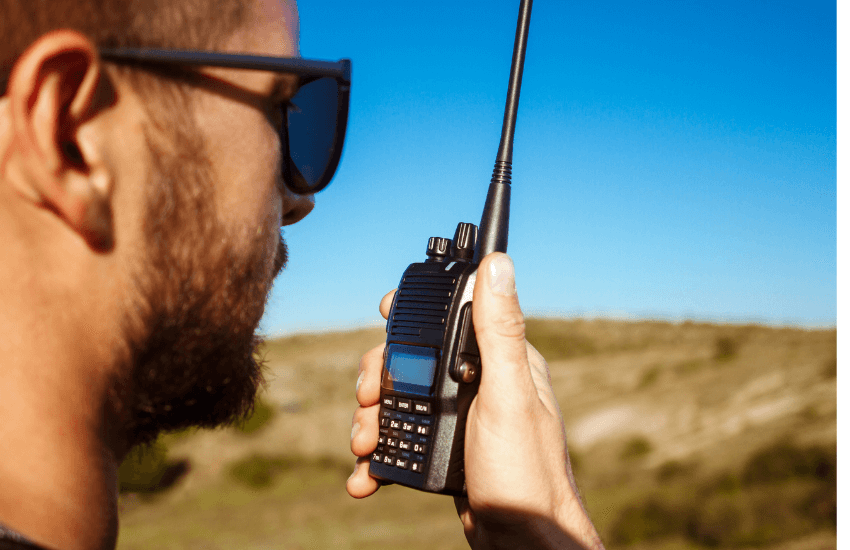
Photo by cookie_studio from freepik Several businesses are modernizing their field communication by implementing PTT solutions. This makes assessing the existing or potential Push-to-Talk provider critical. Here are some of the key considerations to make before you pick your PTT solution provider.
1. Simple User Interface
The prime reason for adopting the PTT technology for your field workforce is to simplify remote communication between various teams. Your PTT solution must have a simple user interface that does not demand much training and complex protocols. Right from adding users to your channels to leveraging push-button connectivity, the PTT app interface must be self-explanatory and easy to use. This ensures that even non-tech savvy field workers can easily connect with their colleagues, without wasting their precious time figuring out processes or raising support tickets.
2. Device Compatibility
Your PTT service provider must offer compatibility with a wide range of devices. Businesses that adopt PTT apps generally deploy Android or iOS smartphones to their field workforce. Most field workers prefer rugged devices over commercial ones to sustain the harsh on-site environments. PTT solutions that are compatible with a wide range of devices such as Android, iOS, rugged devices and custom devices allow businesses the flexibility of use. PTT solutions like NuovoTeam, also offer Desktop PTT capabilities which enable the office staff to leverage PTT connectivity from any machine with a Chrome browser.
3. Clear Pricing Structure
There are several PTT solutions available in the market with diverse features and variable license costs. But does less cost always mean that the solution is cost-effective? There are many solutions that display an appealing license cost but have tons of hidden charges involved. Choose a PTT vendor that offers you a clean pricing plan with no extra charges for registration, set up or locked features.
4. Dashboard Training
Not everyone in your organization is fully tech-savvy. Opting for a Push-to-Talk provider that offers live product demos and dashboard training can help your field workers, as well as your line managers and supervisors, get easily accustomed to the new software. Additionally, you can create product videos to provide on-demand demos and make the onboarding process even smoother. This helps employees understand the solution better and navigate it with ease. It also means lesser support tickets for minor stuck-ups.
5. Pre-Sales Support
PTT vendors that offer pre-sales support allow enterprises to evaluate whether the solution is the right fit for their business needs. You can explore industry use-cases, request quotations and discuss customizations and license plans with the sales teams. This helps businesses make an informed choice.
6. After-Sales Support
PTT vendors that offer after-sales support are definitely to be preferred by businesses. There are great chances of your employees running into errors or technical glitches when using a new PTT solution. Opting for a PTT solution provider who offers after-sales support enables you to leverage anytime help from your vendor. You can gain instant assistance from the product experts for any difficulty that you have throughout your journey.
What Are the Must-Have Capabilities for a Professional PTT Solution?
Every PTT service provider has a different feature set to offer to its customers. Besides exploring the terms, conditions and benefits that various PTT vendors offer, evaluating the features is equally important.
Here are some of the capabilities that you must look for in modern-day PTT solutions:
1. Hands-Free Communication
The sole purpose of implementing PTT for the field workforce is to reduce the tedious dialing and typing procedures and enable your employees to leverage hands-free communication. Most field workers wear bulky protective gear and work in harsh terrains, wherein frequently reaching out for the smartphone in their pocket is not feasible. Modern-day PTT vendors understand this field requirement and offer barge call capabilities in their PTT apps. With this, users are not required to answer the PTT calls. The incoming calls can be heard by everyone in the device vicinity without having to physically receive the call.
2. Group Connectivity
No doubt PTT software offers speedy 1-1 connectivity at the push of a button. But wouldn’t it be nice if this push-button connectivity could be leveraged for group communications as well? Most modern-day PTT solutions enable users to create open and closed groups for team-specific PTT communication. With this, users do not have to make multiple calls to different individuals. A single group PTT call gets the job done and saves massive amounts of time.
3. Emergency or Crisis Communications
An on-site environment is the polar opposite of secure office environments when it comes to physical safety. Mine workers, construction workers, fleet drivers, people working in production lines, etc. operate heavy machinery and work in combustible environments and high-risk zones. PTT communication is not only important for instant connectivity, but also for crisis communication. Features like SOS channels which help your field workforce gather instant help, broadcast emergency updates and more are a must-have in any PTT solution.
4. Strong Feature Set for Business Collaboration
Integrating a PTT app in your employees’ smartphones empowers them to use a single device for multiple purposes. PTT solutions that offer a comprehensive feature set allow your field employees to leverage the best modes of communication. Besides push-button connectivity, the NuovoTeam PTT app offers a plethora of business collaboration features such as video and multimedia messaging, GPS tracking software, text messaging and much more. With multitudes of communication features accessible for a single device, your field employees are never out of options to connect with their colleagues.
5. MDM Integration
Opting for a PTT solution that lets you integrate your MDM solution with it can help you save massive IT time and efforts spent on deploying your PTT app on an organization-wide level. You can distribute the PTT app over the air on multiple devices using your MDM solution. Scalefusion MDM integrates seamlessly with the NuovoTeam PTT app, making it a perfect fit for managing a remote workforce.
Closing Lines
In an ever-competitive market, it is important to not be fooled by fancy-looking services that do not add value to your business. Choosing the right PTT solution for your organization has to be a combination of an effective feature set and great services. NuovoTeam is a powerful PTT solution that helps businesses simplify their field communication.
You can know more about NuovoTeam or request a live demo from our product experts.
-
7 Reasons Why Radios Are Slowing Down Your Company’s Growth
Today, radios are known to everybody. Radio communication has evolved with time and we now see radios not only in homes but also integrated into cars and smartphones. The radio was invented in the late 1800s and has managed to stay in trend for a long time. However, technologies advance with time and today’s mobile-first world is dominated by cellular networks. This brings us to the question – are radios relevant today? Radio communication largely revolutionized various industries back in the day. But failing to adapt to changing times, means failing to move forward. If your business still relies on radio communication, it is time to upgrade. In this article, we will shed light on why radios may be holding your company back. But before we do, let’s take a look at its days of glory.
Radio Communication: Champion of the Past
Radios have a long and interesting history since the time they came into commercial use in the early 1900s. Radio communications were earlier restricted to maritime, to transmit messages from the shore to the ship and vice versa. However, the role of radio communication was vitalized during World War 1 when the military began using the radio exclusively to relay messages to their forces in real-time. Meanwhile, radios also became mainstream in common households.
AT&T was the first to ever release a radio advertisement in 1923. Soon after, radio and BBC became the prime source of news for the public. Then again with the onset of World War 2, radios played a crucial role in communicating the news of the war to the civilians.
Post-war radios still remained in trend and were used as a means of delivering diverse news and entertainment in the form of radio-based talk shows, music hours and much more. On the business front, companies began using two-way radios to simplify their field communication. Cut to today, walkie-talkies and two-way radios are still used by many businesses to stay connected with their field employees. But times have changed and we have progressed into the world of cellular networks where smartphones are mainstream. Clinging on to radio communication may be slowing down your business’s growth. Let’s understand how.
7 Major Pitfalls of Radio Communication: Factors Businesses Must Consider
1. Limited Coverage & Low Audio Quality
If you have ever compared the audio quality of the radio broadcast to that of a cellular broadcast, you must already agree that the call quality over radio frequencies is not the best. Combine the low audio quality with low coverage and you end up wasting minutes in figuring out who is calling or what they are speaking. Radio communication has a very limited reception area. This is a big problem for businesses that have a distributed workforce. With two-way radios, your employees can only communicate with their team members who are in close proximity making public speaking and broader communication efforts challenging.

Photo by Gustavo Fring from Pexels 2. Requires a License
Different countries have different regulations about the use of two-way radios and walkie-talkies. While in some countries, it is legal to use unlicensed walkie-talkies, others like the USA require an FCC license to make use of two-way radios. Businesses need to be aware of these regulations and need to go the extra mile to purchase licenses to operate two-way radios in various parts of the world.
3. No Value for Money
Radios have limited offerings, but a whole lot of costs are included. First off, purchasing dedicated two-way radio devices such as walkie-talkies for your entire crew. Maintaining and repairing these dedicated devices is an additional cost. Moreover, every time you modify your processes or add new members to the team, the licenses too need to be modified. This makes implementing two-way radios an overall costly affair.
4. No Visibility of the Field Workforce
An efficient operational control is difficult to achieve with radio communication. Line managers and supervisors need to be constantly aware of the whereabouts of their deskless workforce. With two-way radios, managers find themselves checking in on their employees way too often. You cannot have definite information on your field employees’ locations, working hours or activities, or integrate real-time updates with database software tools that help analyze workforce performance.
5. Demand the Use of Separate Devices
Today, smartphones are easily accessible and affordable. Everyone owns a smartphone. But if your business relies on radio connectivity, your deskless workers have to carry multiple devices on-site. Two-way radios are bulky and cumbersome to carry around, especially in dynamic frontline and field environments. Your field workforce deserves a single device that has a powerful feature set and simplifies communication.
6. Non Scalable
Radios have very few offerings compared to the dynamic communication requirements of the present-day world. We live in times where cellular and WiFi connectivity over smartphones enables us to share instant images, make real-time video calls, exchange documents and files over the air and so much more. You cannot integrate two-way radios with your corporate platforms or a variety of business applications for task management, location tracking, or even performance testing. By contrast, modern communication platforms can plug into no-code AI tools, letting teams build custom workflows and automations on top of their data in minutes. Neither can you seamlessly capture employee usage data and combine it with intelligence to analyze employee performance. In comparison to the lightning speed at which modern-day communication is evolving, radios just do not offer enough scalability.
7. Do Not Offer Enterprise-Grade Security
All businesses value their corporate data and are aware of the implications of losing out on sensitive customer information or business data. With the ever-evolving cyber threats, radios may not be the best way to communicate business-critical information to your deskless workforce. Several other users may be using the same radio frequency as your organization. In a competitive corporate environment that has several stringent data protection laws, it is best to opt for a communication method that enables end-to-end encryption.
Time to Switch to PTT Over Cellular
The reason why radio communication in the form of two-way radios or walkie-talkies has been alive for so long is because of the immense benefits that it offers to field employees. But, at the same time, is it worth suffering the above-mentioned challenges? What if there is a way to combine the push-to-talk capabilities of the two-way radios with cell phones? Push-to-Talk over cellular or PoC or PTToC offers businesses the best of both worlds. You can experience hassle-free push-button connectivity by simply downloading PTT software on your cellphones.
NuovoTeam is a PTT software that can be easily installed on Android & iOS smartphones to deliver ultrafast push-button field communication. Your deskless workers need not switch between multiple devices on-site, they can turn their smartphones into walkie-talkies effortlessly. NuovoTeam not only offers the PTT functionality but a plethora of other powerful communication features including video messaging, file sharing, location sharing, SOS alerts and much more, which makes it a perfect choice for business communications.
Closing Lines
Remote communication is a vital factor, especially for businesses that have a field workforce. Prevent your company from using outdated radio connectivity and switch to a faster and simpler means of communication with NuovoTeam.
-
6 Best Ways To Use Push-to-Talk (PTT) Technology in 2022
Although we have seen a sharp increase in remote working over the last few years, some industries have always had a remote or field workforce. Construction workers, mine workers, warehouse agents, as well as security guards, firefighters, hotel staff, etc. have always been a part of the deskless workforce. The concept of Push-to-Talk technology is not new to the field workforce. Walkie-talkies, two-way radios, and Land Mobile Radios (LMRs) have been used for ages to keep the field workforce connected. However, due to the big list of shortcomings that these radio communication tools present, the PTT technology has upgraded itself and is now capable of being integrated into smartphones which can be leveraged over cellular networks – PTT over cellular (PoC).
These PoC systems are created by installing PTT software on the field employees’ smartphones, which helps the device mimic the functionality of a walkie-talkie. Most businesses that have a field workforce are investing in PTT software to enable instant connectivity to their field employees from anywhere in the world. A report suggests that the global Push-to-Talk market size is expected to grow from USD 29.2 billion in 2021 to USD 45.2 billion by 2026.
Benefits of Modern-Day Push-to-Talk for Businesses
Integrating Push-to-Talk functionality in smartphones allows businesses to experience the best of both worlds. You can have PTT connectivity straight from your smartphones, without carrying around extra dedicated devices that pose coverage restrictions. You can use your slick smartphone to leverage ultra-fast PTT connectivity over cellular networks.
Here’s a list of benefits your business can experience with the modern-day PTT:
- You can manage your field workforce across geographies. Distance and coverage need not be a barrier to seamless communication.
- You can establish reliable and to-the-point communication in time-critical field operations.
- You can create and execute group calls. This helps reduce time on individual phone calls and also reduces call costs for businesses.
- You can enable hands-free and eyes-free communication for your field workforce.
- You can skip lengthy dialing and typing procedures, simply press the button and talk.
- You can keep your field workforce well-engaged by broadcasting critical information and company-wide updates.
- You can discuss critical matters in real-time for better decision-making.
Also read: How Does the NuovoTeam Push-to-Talk App Solve Field Service Communication Challenges?
How Can Various Industries Make the Most of the PTT Technology?

Photo by Drazen Zigic from Freepik Diverse industrial sectors have a large field workforce that keeps their company’s processes running smoothly beyond office perimeters. The modern-day PTT technology can streamline communication for all these on-field teams.
Let’s understand how various businesses can use the PTT technology to their advantage:
1. Construction
PTT allows multiple teams across diverse construction sites to coordinate. Site managers can broadcast important operational updates or convey emergencies across their field workforce speedily.
2. Logistics & Transportation
Line managers, warehouse employees, dispatchers and delivery agents can connect instantly with the fleet drivers using PTT. Drivers can conveniently share real-time locations to keep the other units of the supply chain informed about their arrival and departure.
3. Retail
PTT allows your sales executives to amp up their customer service by communicating with various teams from anywhere. You can create multiple channels to conduct group PTT calls to offer speedy resolutions to your customers. Whether you want to get in touch with your warehouse employees to find out the stock availability or share instant images and videos of the in-house products, modern-day PTT software enables all of it with a single platform.
4. Security Services
Security services are required by almost all businesses today. You see professional security guards present at stores and restaurants, event security managers at various functions, and surveillance operators monitoring tonnes of CCTVs with a common goal of offering protection. When it comes to the safety of personnel or property, security guards need to be constantly aware of their surroundings and stay in touch with their crew. What better than push-button connectivity to coordinate with your team? PTT apps serve the purpose of rapid communication, along with other useful features such as location sharing, over-the-air image & file sharing and SOS alerts.
5. Hospitality
Customer experience is critical to improving market presence in the hospitality industry. Hotels, restaurants, movie theaters, and airports have a large on-site staff for seamless operational efficiency and enhancing customer experience. Hotels, restaurants, movie theaters, and airports rely on large on-site staff to ensure seamless operational efficiency and deliver exceptional customer experiences. In the same way, a hotel SEO agency works behind the scenes to optimize visibility and enhance the digital experience for guests searching online. Implementing PTT software can help your front desk employees coordinate easily with housekeeping, ground staff or on-site support staff.
6. Emergency Services
When public safety is involved, traditional modes of communication fall short in terms of speed and reliability. PTT enables emergency communication which is vital for first responders. Be it firefighters, ambulance drivers or policemen, PTT helps these everyday heroes with what matters most – speedy connectivity.
NuovoTeam Push-to-Talk (PTT): A Game-Changer for Businesses
NuovoTeam is a PTT app that allows users to leverage PTT over cellular networks. This helps businesses overcome the restrictions of traditional radio-based PTT devices, and helps diverse industries leverage instant press-button connectivity for their field workforce.
NuovoTeam can be easily installed on Android and iOS smartphones using the Google PlayStore or the Apple App Store and has a simple interface. It does not need the user to be highly tech-savvy.
With NuovoTeam, the employees can;
- Experience seamless collaboration not just with PTT, but with several other features such as video and multimedia messaging.
- Find contacts of anyone in the organization using the corporate directory.
- Use a wide range of smartphones (Android Phones or iPhones), rugged devices or custom/purpose-built devices.
- Leverage PTT connectivity from any machine that supports a Chrome browser with NuovoTeam’s Desktop PTT.
- Act quickly and gain instant help in crisis situations with SOS alerts.
- Line managers can gain insights into their field employees’ locations, attendance and working hours.
Closing Lines
Push-to-Talk technology allows you to enjoy rapid connectivity with your field employees from anywhere in the world. PTT helps businesses streamline their communication across their field workforce, a factor neglected by many. You can get the best of PTT connectivity and many more features that collectively help you to improve your bottom-line communication simply by implementing NuovoTeam PTT software.
-
7 Reasons Why Push-To-Talk Is Ideal For Your Organization
When it comes to remote working, smartphones are the most common mode of communication for businesses. You cannot imagine a day without checking your emails, connecting with your colleagues and attending meetings using your smartphone. But, do smartphones always ensure reliable information exchange? Are missed calls and unread messages commonplace, especially when trying to reach your field workforce?
Your field employees are almost always engaged in physical and heavy-duty operations that may not allow them to receive phone calls on time. Push-to-Talk is an ideal way to stay efficiently connected with your field workforce.
Push-To-Talk for Field Communication What is Push-to-Talk?
Push-to-Talk (PTT) is a mode of communication that allows users to leverage voice communication at the press of a button. This method has been traditionally used by devices such as walkie-talkies and two-way radios that function on a half-duplex mode allowing one person to talk at a time over radio frequencies.
The modern-day PTT technology allows smartphones to mimic walkie-talkies and enables users to leverage the same half-duplex mode of communication over the cellular networks. Users can install PTT apps on their smartphones and obtain instant PTT connectivity devoid of complex dialing and typing procedures.
Industries That Benefit the Most From Push-to-Talk
All businesses that have a field workforce can benefit by implementing Push-to-Talk technology to stay connected with their on-field employees. Emails, phone calls and text messages may not be as efficient to communicate with the field workforce. Providing smartphones to your on-field employees with PTT apps installed on them can allow your employees to leverage instant PTT connectivity, without having to carry extra devices.
Some of the key industries that benefit from the modern-day PTT technology are:
- Construction
- Mining
- Warehousing
- Manufacturing
- Oil and gas industries
- Logistics & transportation
- Retail
- Healthcare
- Security services
- Hospitality
7 Reasons Why You Must Pick Modern-Day Push-to-Talk (PTT) for Field Communication
1. Instantaneous Communication
The best advantage of using smartphones integrated with PTT apps is that you can leverage instant connectivity with your field workforce. Employees need not search and dial phone numbers, establish a connection or wait for the receiver to answer the phone, exchange pleasantries and then ultimately convey their message. PTT requires a simple push-button action that saves ample time and offers easy connectivity to your field workforce.
2. Worldwide Coverage
Several businesses have a distributed workforce making streamlined communication a top priority. Modern-day PTT apps can be integrated easily with smartphones allowing instant connectivity over cellular networks. This breaks the geographical barriers presented by two-way radios or walkie-talkie devices. Your field employees can connect with their colleagues or line managers from anywhere in the world.
3. Cost Control
We have already established that making business phone calls may be very time-consuming for your field workforce. But time is not the only thing that is excessively spent on telephone calls, businesses end up spending a lot of money on telephone bills too. Phone calls are longer compared to short and precise PTT calls. PTT helps businesses save costs on excessive cellular and roaming charges. Besides, modern-day PTT apps can be easily installed on your employees’ smartphones which negates the need for businesses to invest in purchasing special PTT devices. Combining PTT with other workflow automation ideas — like automated shift scheduling or task dispatch — compounds these savings even further.
4. Hands-free Communication
Your field workforce operates in harsh environments, with their daily activities involving heavy machinery and labor-intensive processes. On-site employees have a hectic schedule that may not allow them to receive and relay messages on time. But, on the other hand, answering your line manager’s calls is equally crucial. The PTT technology offers the ideal solution to this problem. PTT enables barge calls that can be heard by the employee and everyone in his surroundings as and when received. With this, field employees can receive business-critical information in a hands-free and eyes-free manner, where real-time communication is critical for coordinating logistics, managing schedules, and ensuring seamless event execution.
5. Improved Safety
The field workforce generally operates in high-risk zones with protective gear and gloves. One misstep can lead to an accident or a hazard. Ensuring that every team member follows a proper PPE checklist before entering such environments is crucial for minimizing risk and maintaining safety standards. Having a hands-free mode of communication goes a long way in ensuring the safety of your field employees. Moreover, since PTT enables instant connectivity, it is the most ideal tool for crisis communication. Your employees can send out SOS alerts, convey crisis updates and obtain help faster compared to the other business communication methods.
6. Group Connectivity
Making a phone call may serve the purpose when you want to convey information to a particular employee. However, when business-critical updates need to be conveyed to an entire on-site crew, phone calls are tedious and inconvenient. Modern-day PTT allows you to address a specific group of people and ensure efficient information transfer to your entire crew.
7. Multi-Media Messaging
Modern-day PTT apps not only enable your field workforce to leverage instant PTT connection but also share files of diverse formats such as images, documents, video editing, videos, etc. You can share business-critical documents, receipts, business reports and certificates with your field workforce. Field employees can also share their current location with their fellow colleagues or line managers.
NuovoTeam Push-to-Talk App: Simplifying Field Communications
NuovoTeam is a Push-to-Talk (PTT) app that can be easily integrated with Android and iOS smartphones to keep your field workforce effortlessly connected. With NuovoTeam, businesses can leverage anywhere connectivity with PTT and a line of effective communication features that prevents the information from being siloed.
Why is NuovoTeam the best choice for your business?
- Desktop PTT: NuovoTeam not only simplifies communication for your field workforce but also helps your office staff connect instantly with your on-field employees using Desktop PTT. Line managers and supervisors can make PTT calls from any machine that has the Chrome browser, be it PCs, macOS or Linux machines. With this, your office staff need not constantly switch between PCs and smartphones to make PTT calls.
- SOS Communication: NuovoTeam allows users to create diverse channels for group-specific communication such as public, limited-public, closed and SOS channels. The SOS channel is ideal for crisis communications. Your employees can share a 10-second PTT message followed by the location of the user using the SOS channel.
- Better Call Management: Your employees need not memorize dozens of phone numbers. NuovoTeam consolidates a contact list of all the members of your organization for your employees’ convenience.
- Live Voice Playback: NuovoTeam also ensures that no business-critical message is missed. Employees can replay PTT messages any number of times.
Closing Lines
Your field workforce is a unit of your business that requires constant and stable communication. Modern-day PTT can revolutionize field communication for your business. You can reap the benefits of modern-day PTT by implementing a PTT software that offers simple and powerful enterprise-grade communication.